






Brian Galvin, Veritas Prep’s vice president of academic programs, discussed, on Veritas’ website last year, the internal debate GMAC had with sentence correction (SC) on the GMAT in the early 2000s. Their goal was to create a test that would allow business schools to compare the critical thinking skills of potential students. Central to this objective is administering a fair test. Concerned that sentence correction wasn’t meeting this standard, the GMAC asked, “Is sentence correction unfairly skewed towards native English speakers?”
The GMAC eventually decided that sentence correction was fair because, at its core, the question type is a test of logic, not grammar. Dissecting the soundness of a sentence is simply a proxy for the overall goal of the GMAT. A command of the English language is necessary, but mastery isn’t. Keep this - and the following grammar review - in mind when you’re approaching SC. You can reason your way through a question a lot easier than you can ‘grammar’ your way through it.
Nevertheless, building a strong foundation of English grammar is ultimately necessary to succeed on SC. Depending on your preferences, there are several grammar review options available. Similarly to Quant, prep companies like Veritas and open-source websites like GMATClub.com offer materials. Regardless of your choice, make sure it includes these five topics:
- Verbs
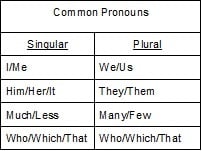
- Pronouns
- Comparisons
- Modifiers
- Parallelism
While there are additional topics you can learn for SC, this grammar review of the above topics is a good start. Don’t focus your studies too heavily on learning every grammar rule or understanding every idiom. Remember, SC is a test of critical thinking - just like Quant. Consider the following as a grammar review of topics you must know before you learn about the strategy you’ll need to dominate SC.
Sentence structure
- The foundation of the English language, sentences are combinations of words that convey the thoughts of the writer. Regardless of complexity, a sentence is based on four main parts: subject, verb, object, and modifier.
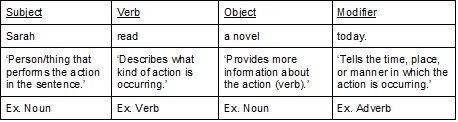
- A sentence may or may not include all four of these parts. As the complexity of the sentence increases - particularly in regards to SC - the subject, verb, and object remain relatively unchanged. The ‘modifier’ section, however, can expand to include additional information at the beginning, middle, and/or end of the sentence.
“Still recovering from the bike accident, Sarah stayed inside and read a novel.”
- Two modifiers, a phrase and a word, were added to provide additional context.
Verbs
Verb tense
- Depending on the tense of a verb – past, present, or future – the verb’s structure will change. Using the verb ‘to study’ as an example, one ‘studies’ in the present; ‘studied’ in the past; and ‘will study’ in the future.
- Verb tenses require conjugation to what time period they’re in, but also to their state. Three categories define a verb’s state: simple, continuous, and perfect:
Simple Tense
Used with verbs that only occur once. For example: “I will study tonight.”
Progressive Tense
Used with verbs that are occurring now and could continue in the future. For example: “I was studying when the pizza arrived.”
Perfect Tense
Used with verbs that occurred before or after another action. For example: “I had been studying for two hours when I ordered the pizza.”
Subject/Verb agreement
- The above rules for verb conjugation are enforced by proper ‘subject/verb agreement’. Depending on whether the subject is singular or plural, the verb’s tense will change. For example, on the verb ‘to be’, singular subjects use ‘is’ and plural subjects use ‘are’.
- On SC, it’s not always easy to find the subject because the test makers actively try to disguise it. A common way they do so is with a modifying phrase. A modifying phrase makes it appear like the subject’s plurality changed, when in actual fact it hasn’t.
“Beyoncé, accompanied by Jay-Z, is dining at Sugarfish tonight.”
SAME AS
“Beyoncé is dining at Sugarfish tonight.”
- Another trap the test makers commonly use is to insert a prepositional phrase into the sentence. While the phrase adds context, it doesn’t actually affect the subject’s plurality.
“The tickets to the Caroline Smith concert are sold out.”
SAME AS
“The tickets are sold out.”




Get closer to your dream programme
Your consent preferences have been set.
Time to start exploring.
Your account has been removed.
You can still browse the site or sign up again once you have parental consent.
Get closer to your dream programme